
Understanding how the brain works and develops is a key part of a trauma-informed approach.
There are three main areas of the brain that are important for us to know about:
- The brain stem: the ‘body centre’ or survival area of the brain is responsible for keeping us alive through heartrate, breathing and temperature regulation. It is already fully developed by the time we are born.
- The mid-brain: the ‘feeling and acting’ centre of the brain is responsible for voluntary movement, play, coordination and emotional recreations. The mid-brain develops fastest from the age of about 6 months to 4 years.
- The cortex: the ‘thinking centre’ of the brain is responsible for more advanced skills like problem solving, reasoning, complex language, planning and understanding cause and effect. It develops rapidly from about the age of 3 years and keeps bringing all sorts of new skills online, all the way until adulthood.
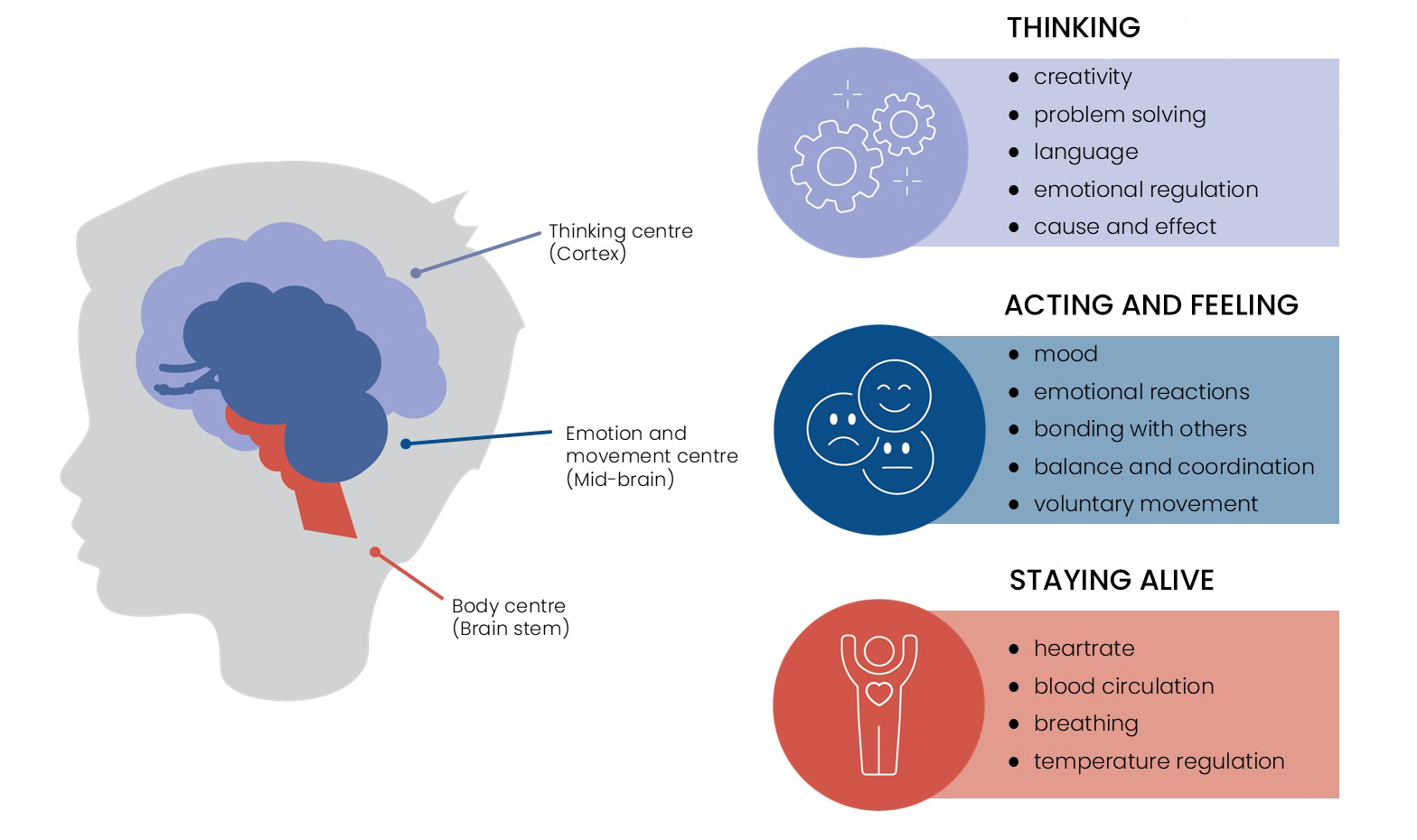
The brain develops from the bottom up — or from the inside out.
As we grow, the part of our brain primarily in control and driving our behaviour changes.
By the time we reach our teenage years, the thinking centre is usually firmly behind the wheel, with the other areas still playing their role.
Teaching children and young people how the brain works can be a powerful tool in helping them learn what is happening if they start to feel overwhelmed and out of control.
However, concepts like ‘fight, flight or freeze’ and ‘survival mode’ might be too abstract for kids to understand.
Another way we explain this is by talking about ‘Flipping your lid’.
This can be a really great tool for kids who want to communicate that they are not doing OK, or are acting in a way they know isn’t OK, but don’t have the words for it or ability to control themselves.
One of the easiest and most effective ways to explain to children is through the Hand Model of the Brain.
The brain section has now provided you with the background knowledge you need to start to understanding trauma and start to support children and young people through trauma-informed coaching.